
Carotid Artery Disease
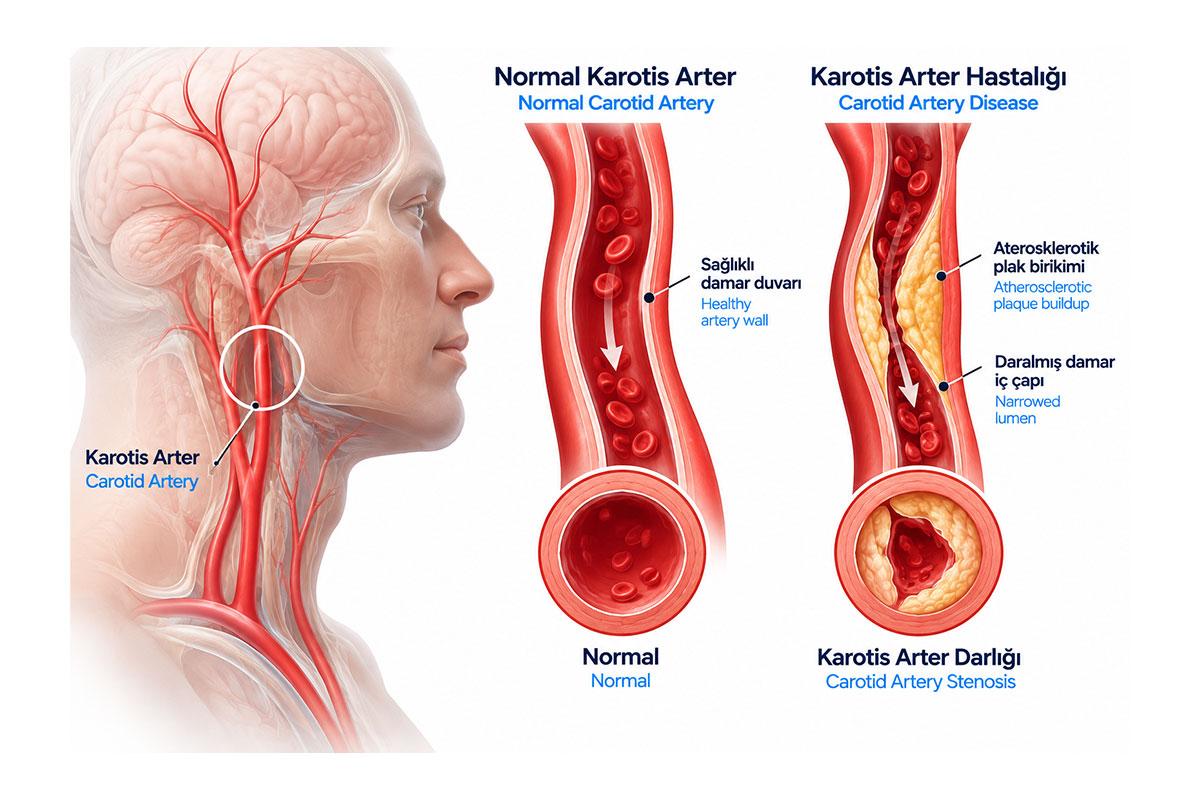
Carotid artery disease is the narrowing of the arteries in the neck that carry blood to the brain, most often due to atherosclerosis. Plaque that accumulates in the artery can reduce blood flow or, more importantly, cause fragments that break off from the plaque to travel to the brain and lead to a stroke or transient ischemic attack (TIA). Carotid artery disease may cause no symptoms at all until a TIA or stroke occurs; for this reason, regular evaluation is important for individuals with risk factors. The treatment approach is personalized based on the degree of narrowing, any history of TIA/stroke, plaque characteristics, and the patient's overall condition.
Carotid artery disease is often silent and may cause no symptoms until a TIA or stroke occurs. IMPORTANT: If any of the following neurological symptoms appear SUDDENLY, this is an EMERGENCY; the nearest emergency department should be reached, or 112 called, without delay.
- Sudden Weakness or Numbness (Especially on One Side of the Body) — Sudden weakness or numbness in the arm, leg, or face — usually on one side of the body — is a symptom of stroke/TIA that requires EMERGENCY evaluation; the emergency department should be reached without delay.
- Sudden Difficulty Speaking — Sudden difficulty speaking, or being unable to understand another person's speech, is a finding that requires EMERGENCY neurological evaluation and calls for reaching the emergency department without delay.
- Sudden Vision Loss in One Eye — Sudden onset of vision loss or blurring in one eye is an EMERGENCY warning sign that may be related to carotid artery disease; immediate emergency medical help should be sought in this situation.
- Sudden Dizziness or Loss of Balance — Sudden dizziness or loss of balance is also among the EMERGENCY symptoms that may indicate stroke/TIA and should be evaluated without delay.
Imaging methods are used to diagnose carotid artery disease and to determine the degree of narrowing and the characteristics of the plaque.
- Carotid Doppler Ultrasonography
- Computed Tomography Angiography (CTA)
- Magnetic Resonance Angiography (MRA)
- Brain Imaging Based on Clinical Indication
- Physical Examination and Neurological Evaluation
Advanced evaluation and treatment planning may be considered when findings suggestive of carotid artery disease are present or when significant narrowing is detected on imaging.
- Detection of Significant Carotid Narrowing on Imaging — Detection of a marked degree of narrowing on Doppler ultrasound or angiographic imaging may require treatment options to be evaluated.
- History of Previous TIA or Stroke — In patients who have recently had a TIA or stroke and are found to have carotid narrowing, the treatment decision may be addressed more urgently.
- Plaque Characteristics and General Health Status — The structure of the plaque, along with the patient's age and general health status, may be determining factors in choosing the treatment method to be applied.
- Surgical/Interventional Risk Assessment — Assessing the patient's surgical and procedural risk together with the carotid anatomy can help guide the choice between stenting and surgery.
Treatment of carotid artery disease is planned in a personalized manner, taking into account the degree of narrowing, symptom status, plaque characteristics, and the patient's individual risk factors.
- First Step — Risk Factor Control and Medical Therapy — Smoking cessation and control of blood pressure and cholesterol, together with medications such as antiplatelets and statins, form the foundation of treatment in all patients.
- Regular Imaging Follow-up — In mild-to-moderate narrowing, regular carotid Doppler ultrasound follow-up may be recommended to monitor progression.
- Carotid Artery Stenting — Catheter-based carotid artery stenting may be considered as a treatment option, particularly in selected patients with certain anatomical and clinical characteristics.
- Carotid Endarterectomy (Surgery) — In suitable patients, particularly those with significant symptomatic narrowing, surgical removal of the plaque (endarterectomy) may be considered.
After treatment for carotid artery disease, regular follow-up is important for maintaining vessel patency and managing stroke risk.
- Regular Doppler Ultrasound Checks — Carotid Doppler ultrasound follow-up performed at determined intervals after treatment helps monitor vessel patency.
- Adherence to Medical Therapy — Regular use of medications such as antiplatelets and statins helps reduce the risk of a new event.
- Management of Risk Factors — Controlling blood pressure, cholesterol, and blood sugar, and maintaining abstinence from smoking, are important for long-term outcomes.
- Monitoring for Neurological Symptoms — Any neurological symptom that develops suddenly after treatment requires emergency evaluation without delay.
The information here is for general informational purposes; the diagnosis and treatment plan are determined following an individualized evaluation.