
What Is Coronary Angiography?
Coronary angiography is a minimally invasive procedure that images the arteries supplying the heart (the coronary arteries). It shows whether there is narrowing or blockage in your arteries and, if present, its location and severity. During the procedure, a thin catheter is inserted into an artery — usually the radial artery in the wrist — and advanced to the heart. Contrast dye is then injected to visualize the arteries and X-ray images are taken.
- Catheter-Based
- Method
- Local Anesthesia
- Anesthesia Type
- Usually Same-Day
- Hospital Stay
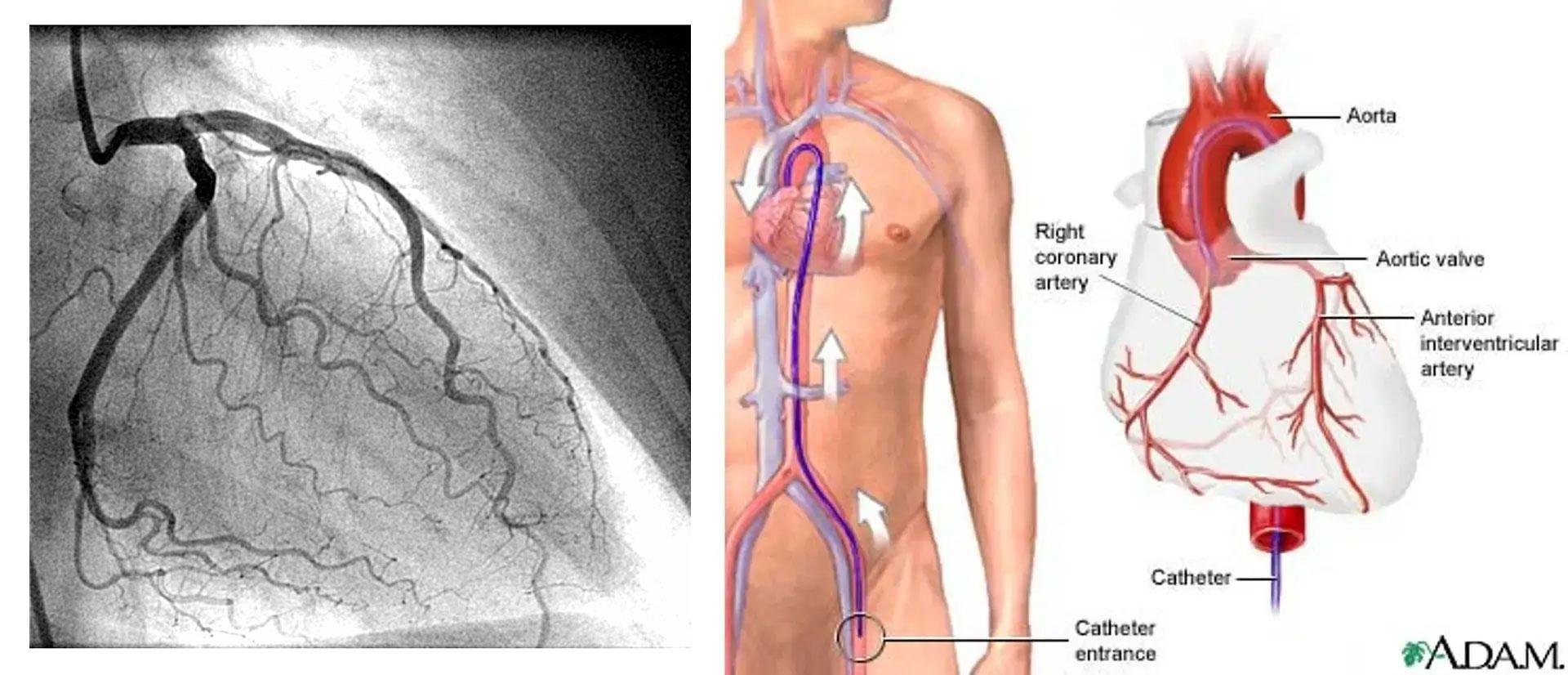
Who Needs Coronary Angiography, and When?
Coronary angiography may be considered when there are complaints or findings that raise suspicion about the heart's arteries, in order to directly visualize the structure of the arteries. The situations below are example scenarios in which this procedure may be considered for evaluation; the final decision depends on the patient's individual examination.
Patients With Chest Pain
When the source of chest pain occurring with exertion or at rest needs to be investigated, this procedure may be considered to clarify the condition of the coronary arteries.
Suspicious Findings on Non-Invasive Tests
It may be considered for further evaluation in patients with a suspicious result on tests such as an exercise stress test, myocardial perfusion scintigraphy, or coronary CT angiography.
Follow-up of Known Coronary Artery Disease
In patients previously diagnosed with coronary artery disease or with a history of stent placement or bypass surgery, re-evaluation of the arterial structure may be needed if symptoms recur.
Suspected Acute Coronary Syndrome
In sudden-onset complaints suggestive of a heart attack, it may be performed on an emergency basis to rapidly determine the location and degree of blockage.
Difference Between Coronary Angiography and Coronary CT Angiography
Coronary Angiography (Catheter Method)
An interventional procedure performed by injecting contrast dye into the artery through a catheter inserted via the groin or wrist; depending on the findings, the possibility of proceeding to treatment in the same session may also be considered.
Coronary CT Angiography
A non-invasive imaging method performed using a computed tomography scanner and intravenous contrast dye, without inserting a catheter into the artery; it is diagnostic in purpose and does not offer treatment.
What Does Coronary Angiography Determine?
With coronary angiography:
Included
- Whether there is significant narrowing or blockage in the heart's arteries
- The location and degree of the narrowing
- Whether balloon or stent treatment is needed
- Whether further treatment or additional investigation is needed
Not included
Assessment and Approach
Before and during coronary angiography, certain assessment steps are followed to ensure patient safety and accurate interpretation of the results.
Detailed History and Test Review
Before the procedure, the patient's complaints, existing test results, and any coexisting conditions are evaluated together.
Contrast Dye Safety
Since this procedure involves the use of contrast dye, kidney function and possible allergic conditions are reviewed beforehand.
Access Site Selection
Which access site — groin or wrist — is appropriate is decided based on the patient's arterial structure and overall condition.
Post-Procedure Monitoring
After the procedure, the access site and the patient's overall condition are monitored for a certain period.
How Is the Procedure Performed?
The procedure is usually performed via the wrist and takes about 15 minutes. Patients are generally discharged the same day.
Factors Affecting the Assessment
The suitability and timing of coronary angiography are determined by taking into account individual clinical factors such as the following.
General Health Status
The patient's age, coexisting conditions, and overall health status are taken into account during the assessment.
Previous Test Results
Results from previously performed tests such as an exercise stress test, echocardiography, or coronary CT angiography are included in the assessment.
Kidney Function
Since contrast dye is used during the procedure, kidney function is an important assessment criterion.
Vascular Structure and Anatomical Features
The choice of access site and procedure planning are shaped by the patient's anatomical features, such as vascular structure.
The information provided here is for general informational purposes; the diagnosis and treatment plan are determined following an individualized assessment.
Frequently asked questions about Interventional Cardiology
Coronary angiography is an interventional diagnostic method in which the coronary arteries supplying the heart are imaged under X-ray (fluoroscopy) after contrast dye is injected via a catheter. It allows direct visualization of any narrowing or blockage in the arteries.
It may be performed to investigate the source of complaints such as chest pain, to clarify the condition of the coronary arteries in patients with a suspicious finding on tests such as an exercise stress test or CT angiography, or to assess the course of known coronary artery disease.
If you have heart-related complaints such as chest pain or shortness of breath, or if a suspicious finding related to the coronary arteries has been detected on your tests, it may be recommended to directly visualize the structure of the arteries. This recommendation is based on an individual assessment your physician will carry out with you.
The procedure begins with the placement of a thin catheter into an artery in the groin or wrist under local anesthesia. The catheter is advanced to the coronary arteries, and contrast dye is injected to image the arteries under fluoroscopy.
After the procedure, the access site is closed and the patient is kept under observation for a period. The hospital stay is generally short; the imaging results and any next steps are discussed together with the patient.
No. Coronary angiography is an interventional procedure performed by inserting a catheter into the artery, while coronary CT angiography is a non-invasive imaging method performed using computed tomography. Each may be preferred for different purposes and in different situations.
Get in touch with us for an evaluation
Send your appointment request; we'll let you know about the evaluation process suited to your complaint and needs.