
What Is Holter ECG?
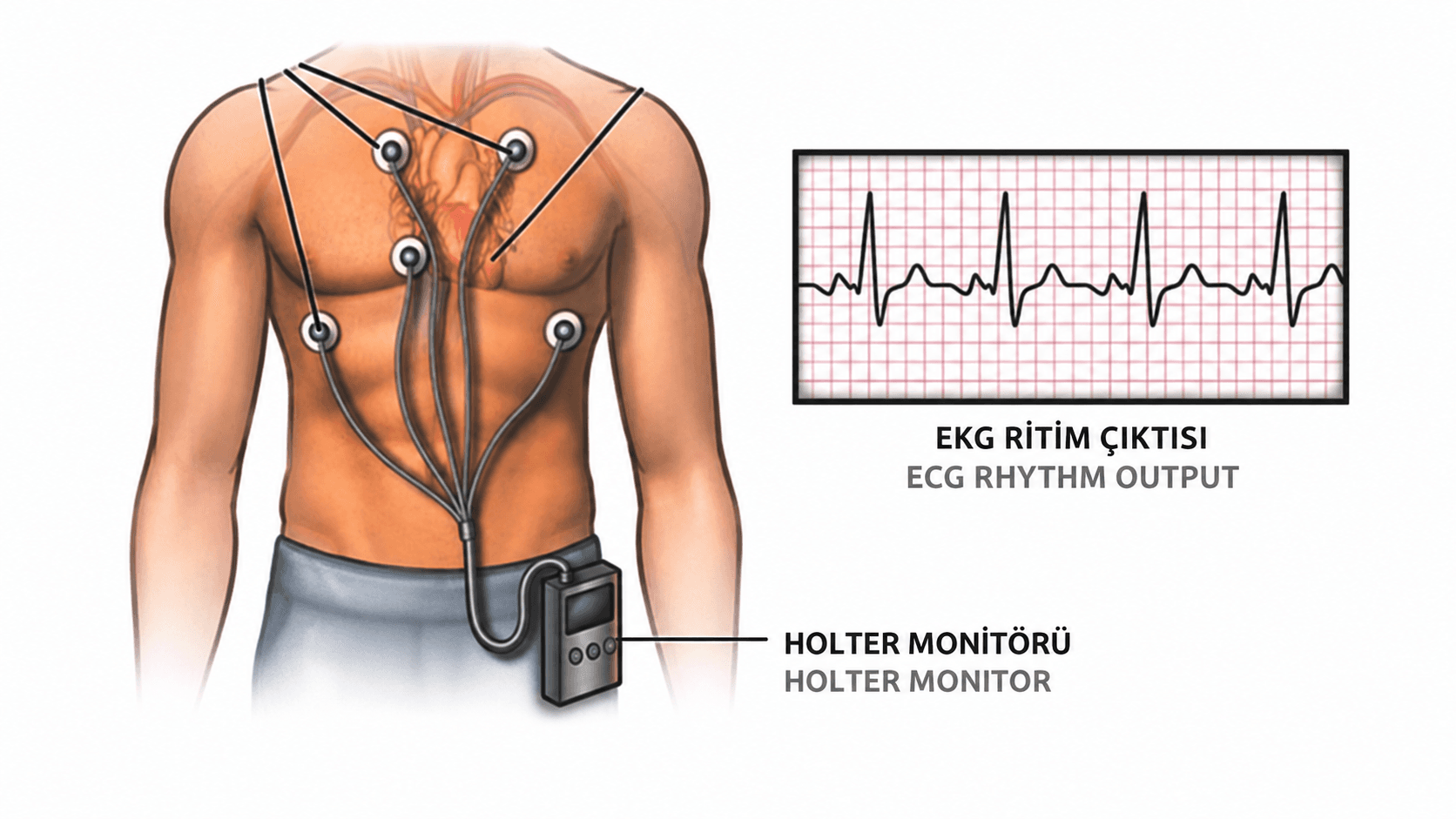
Holter ECG is a portable device that continuously records the heart rhythm during daily life. It is generally used for 24-72 hours; longer recordings can be made when necessary. It is used particularly to investigate palpitations, dizziness, fainting, and intermittently occurring rhythm disorders.
- 24-72 Hours
- Recording Duration
- Portable Device
- Method
- Analysis After Recording
- Result Process
Who Needs Holter ECG, and When?
Holter ECG may be considered to investigate rhythm-related complaints that are not captured during a standard ECG but occur intermittently in daily life. The situations below are example scenarios in which this test may be considered; the final decision depends on the patient's individual examination.
Intermittent Palpitations
It may be requested to investigate palpitations that occur from time to time and cannot be captured during a standard ECG.
Unexplained Dizziness or Fainting
It may be used for episodes of dizziness or fainting of unclear cause, to evaluate whether there is an underlying rhythm disorder.
Follow-up of Known Arrhythmia Treatment
In patients previously diagnosed with a rhythm disorder and currently undergoing treatment, it may be used to monitor treatment effectiveness.
Suspected Intermittent Finding on ECG
It may be considered to investigate findings that could occur intermittently on a standard ECG but cannot be confirmed with a single recording.
Difference Between Holter ECG and an Exercise Stress Test
Holter ECG
Continuously records the heart rhythm over a long period during daily life without requiring any controlled exercise; it is effective at capturing intermittent rhythm disorders.
Exercise Stress Test
Evaluates the heart's response over a short period during a controlled, gradually increasing exercise on a treadmill; it is used to investigate findings triggered by exertion.
What Does Holter ECG Cover?
The Holter ECG process covers specific steps, from fitting the device to analyzing the recordings.
Included
- Placement of small electrodes on the chest and fitting of the portable recording device
- Uninterrupted recording of the heart rhythm for 24-72 hours or the duration deemed necessary
- The patient continuing their daily activities normally (including sleep) during the recording period
- The patient noting the moment complaints occur and the activity being performed (symptom diary)
- Detailed computer-based analysis of the data after the recording is completed
- Assessment of the frequency and duration of any detected rhythm disorders and their relationship to the complaints
Not included
- Holter ECG does not image the heart's structural features; echocardiography is required for this purpose.
- It does not evaluate the heart's response during controlled exercise; an exercise stress test is used for exertion-related findings.
- For very infrequent complaints (for example, once a month), the standard Holter duration may be insufficient; in such cases, longer recording options are considered separately.
Assessment and Approach
Accurate Holter ECG results depend on correct device use and careful analysis of the recordings.
Correct Electrode and Device Placement
Care is taken to place the electrodes in the correct positions and to fit the device securely, in order to ensure recording quality.
Patient Information
The patient is clearly informed about how to continue their daily life with the device and in which situations they need to keep notes.
Matching with the Symptom Diary
Complaints felt during the recording are matched in time with the electrical recording and interpreted accordingly.
Detailed Recording Analysis
The collected data is systematically examined in terms of the type, frequency, and duration of any rhythm disorders.
How Does the Holter ECG Process Work?
Holter ECG is a process consisting of several stages, from fitting the device to evaluating the results.
- 01
Before Recording
Fitting the Device
Electrodes are placed on the chest and the portable recording device is connected to the patient.
- 02
During Recording
Continuing Daily Life
Apart from a few restrictions such as bathing, the patient continues their daily activities normally.
- 03
During Recording
Recording Complaints
Complaints such as palpitations or dizziness felt during the recording, along with their timing, are noted by the patient.
- 04
After Recording
Removal of the Device and Analysis
When the recording period is complete, the device is removed, the recordings are analyzed, and the results are shared with the patient by the physician.
Factors That Affect the Assessment
The duration and scope of assessment for Holter ECG are determined by individual factors such as those below.
Frequency of Complaints
How frequently the complaints occur is an important factor in determining the required recording duration (24, 48, 72 hours, or longer).
Nature of the Presenting Complaint
The complaint the patient presents with — such as palpitations, dizziness, or fainting — determines the focus of the assessment.
Known History of Rhythm Disorder
A previously diagnosed arrhythmia or history of treatment affects how the recording is interpreted.
Previous ECG and Other Test Results
Any previous test results, such as ECG or echo, are included in the current assessment.
The information here is for general informational purposes only; the diagnosis and treatment plan are determined based on an individual assessment.
Frequently asked questions about Diagnostic Cardiology
Holter ECG is a portable, painless device that continuously records the heart rhythm during daily life. It is generally used for 24-72 hours.
It is performed to investigate intermittent complaints such as palpitations, dizziness, or fainting that cannot be captured with a standard ECG, or to follow up a known rhythm disorder.
It may be recommended if you have complaints that occur from time to time, such as palpitations, dizziness, or a feeling of fainting, in order to investigate whether these complaints are related to your heart rhythm. This recommendation is based on the individual assessment your physician will make with you.
Yes. Because the device is portable, you can continue your daily activities normally, apart from a few restrictions (such as bathing).
After the recording period is complete and the device is removed, the data is analyzed; the results are generally evaluated by the physician and shared within a few days.
No. A standard ECG provides a short recording at a specific moment, while Holter ECG continuously records the heart rhythm for 24-72 hours or longer and is more effective at capturing intermittent rhythm disorders.
Get in touch with us for an evaluation
Send your appointment request; we'll let you know about the evaluation process suited to your complaint and needs.