
What Is SVT Ablation?
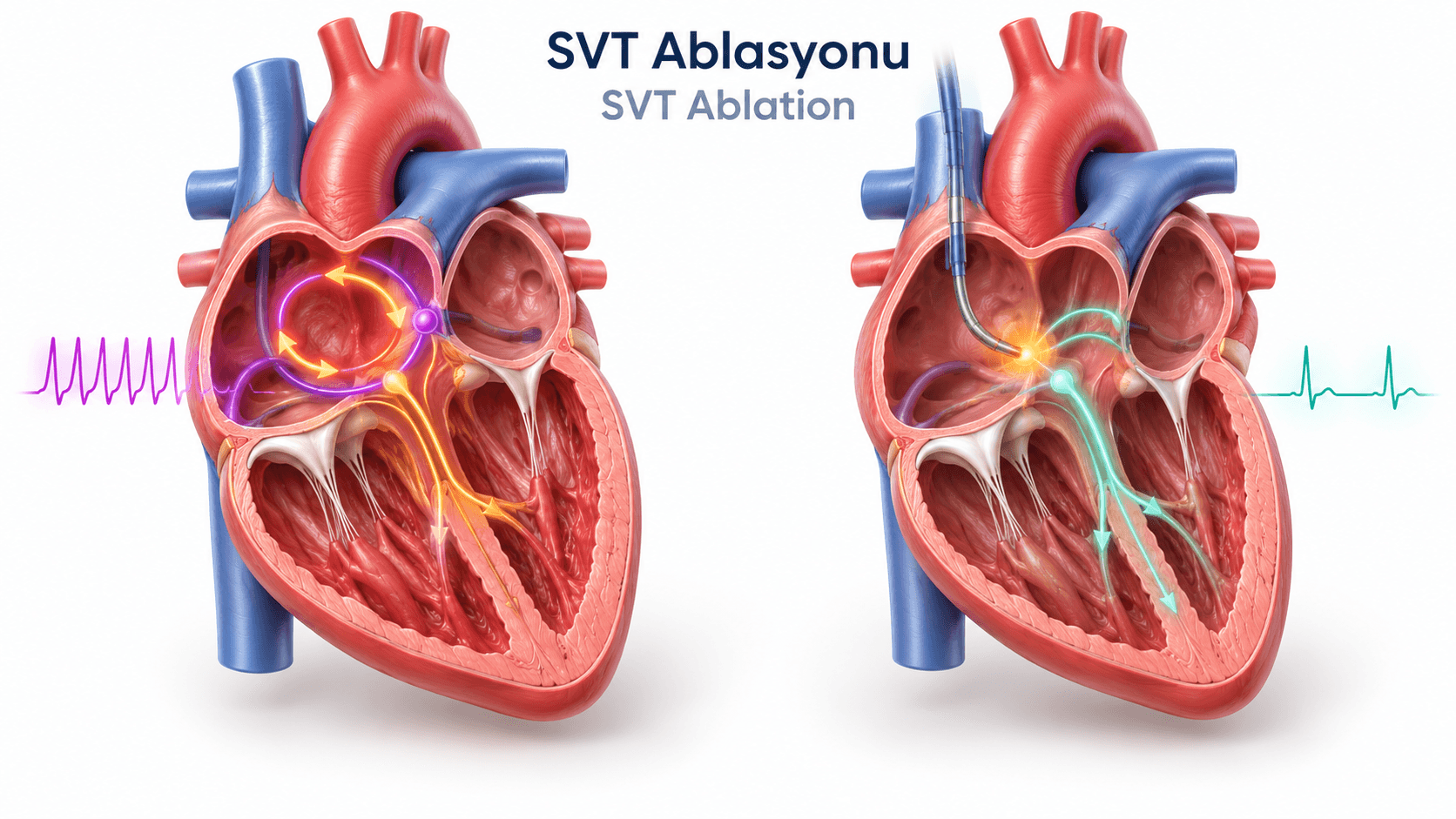
SVT (Supraventricular Tachycardia) is a general term describing fast heart rhythms that begin above the heart's ventricles.
- Catheter-Based
- Method
- Local Anesthesia / Sedation
- Anesthesia Type
- Usually Same-Day
- Hospital Stay
What Are the Symptoms of SVT Episodes?
Episodes usually start suddenly and may cause the following complaints:
Palpitations
The heart beating very fast
Dizziness
Chest discomfort
Shortness of breath
What Results Can SVT Ablation Provide?
Catheter ablation can eliminate the abnormal electrical pathway or focus causing this rhythm disorder. The success rate of ablation is high for common SVT types, and it may provide lasting treatment in suitable patients.
Included
Not included
Evaluation and approach
Before and during SVT ablation, the primary focus is on accurately identifying the rhythm disorder and following a safe procedure process.
Detailed rhythm diagnosis
Before the procedure, the type and source of SVT are clarified using ECG, Holter recording, and, when necessary, electrophysiology study.
Individual anatomical evaluation
The heart's electrical structure and the location of any accessory pathways are taken into account in procedure planning.
Continuous monitoring during the procedure
Heart rhythm is closely monitored throughout catheter advancement and energy delivery.
Comprehensive clinical evaluation
Accompanying heart conditions and general health status form part of the pre-procedure evaluation.
How Long Does the Procedure Take?
SVT ablation generally takes 30–60 minutes, and patients are mostly discharged the following day.
Clinical suitability evaluation
The suitability of SVT ablation is determined not by a fixed criterion but as the result of a multi-faceted, patient-specific evaluation process.
General health status
The patient's age, accompanying chronic conditions, and overall clinical picture are a core part of the evaluation.
Previous test results
ECG, Holter recording, and, if available, previous electrophysiology study findings are taken into account in procedure planning.
Type and course of the rhythm disorder
The clinical picture of SVT, along with the frequency and duration of episodes, plays a role in determining the approach to be taken.
Anatomical characteristics
The heart's electrical structure and the condition of the vascular sites to be used for catheter access are evaluated.
The information here is for general informational purposes; the diagnosis and treatment plan are determined following an individualized evaluation.
Frequently asked questions about Interventional Electrophysiology
SVT ablation is an interventional method used to treat supraventricular tachycardia (SVT), which originates from the heart's upper chambers (atria) and causes fast palpitation episodes that start and stop abruptly. Using catheters advanced from the groin or neck region, an electrical map of the heart is created, and the abnormal pathway causing the episodes is targeted with energy. The procedure is performed together with electrophysiology study (EPS) in the same session.
SVT ablation aims to offer a solution targeting the source of the episodes by eliminating the abnormal electrical conduction pathway causing recurring palpitation episodes. It is considered an option particularly when episodes recur frequently, affect daily life, or are not adequately controlled with medication.
This procedure may come up in patients whose SVT diagnosis has been confirmed through ECG, Holter recording, or symptomatic presentation, and whose quality of life is affected by episodes. The recommendation is determined individually by evaluating together the type of the patient's rhythm disorder, the frequency of episodes, response to medication, and general health status; it is not offered as a general rule.
The procedure begins with thin catheters being advanced to the heart through a vessel in the groin or neck. First, the heart's electrical activity is mapped with electrophysiology study (EPS) to identify the abnormal pathway causing SVT; this area is then targeted with radiofrequency or cryoenergy to neutralize it. The heart rhythm is continuously monitored throughout the procedure.
After the procedure, the patient is kept under observation for a short time, the catheter access site is checked, and the heart rhythm is reassessed. Most patients are discharged the same day or after a brief hospital follow-up; check-up examinations are then planned at defined intervals.
Medication aims to reduce the frequency or severity of palpitation episodes without eliminating the source of the rhythm disorder, and generally requires regular use. SVT ablation, on the other hand, directly targets the abnormal electrical pathway, offering an approach aimed at the source of the episodes. Which method is suitable is determined through individualized evaluation.
Get in touch with us for an evaluation
Send your appointment request; we'll let you know about the evaluation process suited to your complaint and needs.